Seasoning - Rave Culture is Folk Culture
Rave Culture is
Folk Culture
Not a weekend away from life, but a durable scene inside it. Something earthy, bass-led, porous and strange.
Abstract
This document reconstructs the Seasoning belief system as a field paper. Its core claim is simple: rave is not an imported spectacle, nor a lifestyle accessory, but a living folk practice carried by systems, memory, place and repeated gathering. What follows traces that claim through Stroud’s local ecology, through sister parties and partner crews across the UK, through the soundsystem understood as a boundary object, through hospitality to the stranger, and through the low-end, diasporic, technically adventurous listening culture that Seasoning has tried to hold open.
I. Proposition
Seasoning began in Stroud with a simple conviction: that rave is not an imported spectacle or a lifestyle accessory, but a living practice held together by people, places, memory and repetition. To say rave culture is folk culture is to insist that this music belongs to the people who keep carrying it. Folk culture is not a museum object. It is a social technology. It survives by being handed on, bent, reworked, argued over and brought back to life in new rooms. Rave works the same way. A tune becomes a tool, a rig becomes a gathering point, a smoking area becomes a seminar, an old lockup full of records and half-broken gear becomes an archive.1
In Stroud, that archive is not only formal. It lives in whispered recommendations, borrowed equipment, old dubplates, battered flight cases, and the stories that pass between generations in the gaps between sets. This is the ineffable Stroud connection not as myth for branding, but as a real social weave of local memory, practical resourcefulness and collective appetite. It is there in the line between the smoking area and the booth. It is there in the old forgotten lockups of record collections and rave gear. It is there in the knowledge that scenes survive because somebody keeps the cables, remembers the route, lends the monitors, or passes on the right plate at the right time.
Routes, not roots. Or rather: roots carried through routes.
Folk culture is not nostalgic. It is not heritage for display. It is living practice. It belongs to those who participate in it, who sustain it, who pass it on through doing. It shifts with each generation, absorbing new technologies, new sounds and new conditions while holding onto something essential: a way of gathering, a way of organising space, a way of being together.
1. For the sonic version of this argument, see Simon Reynolds, Energy Flash: A Journey Through Rave Music and Dance Culture; and for the social and political history of dancing in Britain, Ed Gillett, Party Lines: Dance Music and the Making of Modern Britain. Paul Sullivan’s Remixology: Tracing the Dub Diaspora remains essential in understanding dub not just as a style but as a method and an infrastructure of circulation.
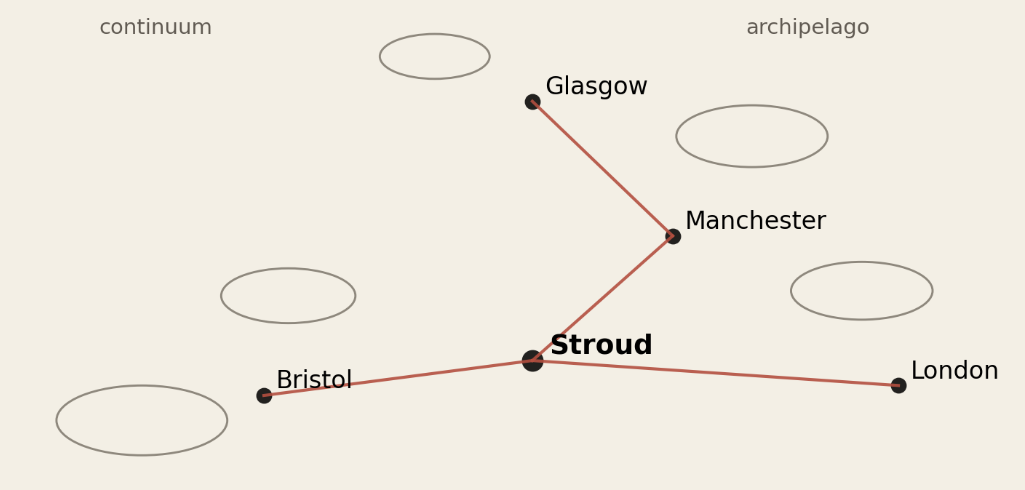 Figure 1: From continuum to archipelago: a schematic shift from linear genre succession toward a distributed network of scenes, with Stroud as a local node rather than a peripheral afterthought.
II. The Stroud Node
Stroud sits within its own lineage. The South West has long held a particular relationship to rave: fields, rural infrastructures, travelling systems and temporary autonomy. A different scale, a different pace, but part of the same wider network. Culture is always located.
Seasoning is built from this place.It is local and open at the same time, a meeting point between Stroud and the wider underground, between emerging artists and established ones, between different scenes, different communities and different ways of understanding sound. This localism is not defensive. It is what Stuart Hall would call positional: rooted enough to speak clearly, open enough to keep articulation alive.
Seasoning’s public history shows that it has already been building this weave for years. The event archive runs from early SVA parties in 2022 through Studio 18, The Goods Shed, Bristol link-ups, solidarity fundraisers and on into the 2026 full weekend festival. That timeline matters because it shows continuity: the same Stroud nucleus gradually learning how to host bigger conversations without losing its own grain.Lovellious appears right at the start in the first SVA event in April 2022 and keeps reappearing across the project’s history, which makes the Love Cuts axis especially important. Love Cuts is not just an alias or side project. It is a practice of edits, reworks and rethinks, flipping restless soul, eskibeat, jungle and broken beat into new club forms. That is folk process in miniature: not origin myths, but practical versioning, the passing on of materials through touch and use.
A local edit is a folk form. So is a dubplate. So is a city-to-city link that still feels handmade.
What we are trying to build, then, is not a weekend away from life. It is a durable scene inside life. Something earthy, bass-led, porous and strange. Something that can still be felt in the smoking area after dawn, and in the knowledge that this music only stays alive if people keep gathering to pass it on.
III. Hospitality and the Stranger
A dancefloor worth building has to think about hospitality. Not hospitality in the shallow sense of service, but in the deeper ethical sense given to it by Emmanuel Levinas: the room as a site of encounter with the stranger. Here the other is not reduced to the familiar. The challenge is to remain open without demanding sameness in return. Rave does not dissolve difference. At its best it suspends the demand to resolve it.This matters because Seasoning is not trying to produce a closed local identity. It is trying to build a room in which strangers can arrive carrying other places inside them. The host is changed by that arrival. The room is changed by it too. A local scene becomes durable not by purifying itself but by learning how to receive pressure, unfamiliarity and the social risk of encounter.
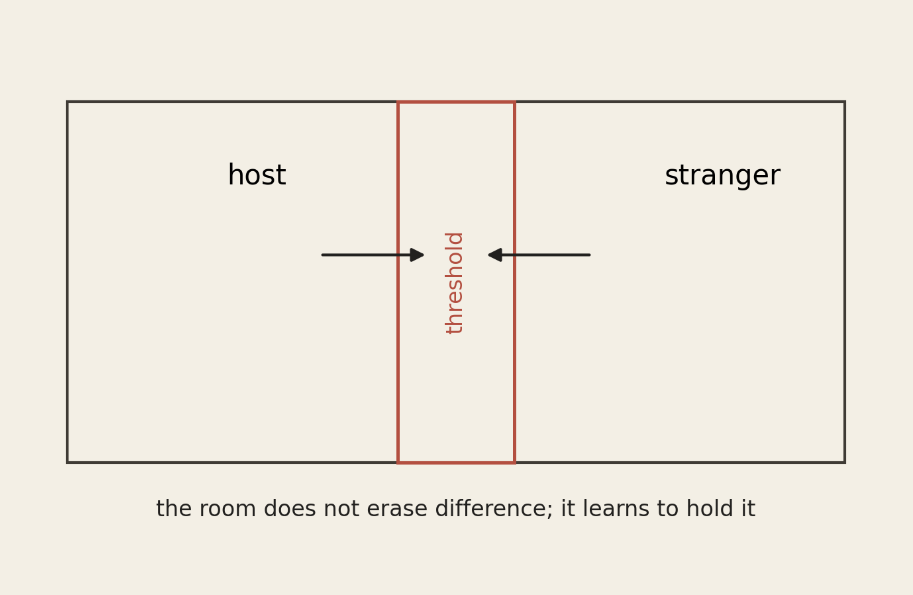 Figure 2: Hospitality as threshold relation: the room does not erase difference; it learns to hold it.
IV. Nomadic Systems and Parochial Cosmopolitanism
Sound-systems move. They carry memory between places. They arrive already charged with other rooms, other nights, other bodies. Like the travelling circuses of earlier centuries, or the free-party convoys and teknival infrastructures that criss-crossed Britain later on, they build temporary worlds before dissolving again. Each arrival is both local and elsewhere.
This is the real meaning of a parochial cosmopolitanism.Stroud does not need to imitate metropolitan culture in order to become open. It only needs to remain rooted enough to host it properly, and porous enough to let it alter the local grain. Club culture survives through these nomadic transfers: records, rigs, engineers, dancers, MCs, vans, rumours, line checks, route knowledge, rail corridors, road corridors, hand-drawn maps, and all the small social improvisations that get people into the same room.
There is an escarpment futurism latent in this. Stroud’s horizon is not the smooth horizon of a capital city but the broken horizon of ridgelines, valleys, cuttings and hidden routes. A future is imagined here from the edge, not the centre. It is one reason the phrase Stroud Acid Arabia has force. Not as slogan, and not as an identity to be claimed whole, but as a speculative geography: an impossible conjunction in which pastoral English edge-lands meet diasporic pressure, low-end psychedelia and soundsystem nomadics without either term being dissolved into the other.
V. Constellation of Sister Parties
If Seasoning has a method, it is to build local practices into a wider constellation without flattening their differences. The point is not to borrow somebody else’s aura and staple it to a flyer. The point is to understand what kinds of rooms these parties have built, what social temperatures they hold, what values they test in public, and how those values might be brought into relation in Stroud. This is a question of social ecology: not only who plays, but what relations are made possible between organisers, listeners, stewards, systems, venues, neighbours and the informal infrastructures that let a scene persist.2Club Blanco matters because it demonstrates how curation can mediate between underground knowledge and a broader public without flattening either. Its public traces across Bristol move from free-entry courtyards into all-day industrial spaces and after-hours rooms, testing how acid, psych, house and minimal pressure can coexist without becoming a mood-board.Cabin Fever is useful for different reasons. Its force lies in how it sustains coherence through experimentation, drawing two parallel musical journeys into a room that feels rigorous without becoming austere.Spirit reintroduces mysticism to club practice. It treats sequence as ritual technology rather than scheduling, so that the room is felt as a passage, not a timetable.JoyLift exemplifies Bristol’s ongoing mutation of bass into forward-facing club abstraction. It shows how local inheritance can be made modern without freezing it in reverence.How We Met pushes the social side further, treating party as an ecology of art, performance, movement and mutual lift rather than a booth-centred hierarchy.Immigrant Party, led by Dan Parties from Brazil and Chase Tha Worst from Trinidad, sharpens the argument again. Its public vernacular imagines a borderless, passport-free zone where global south rhythms and heavy organic movement displace the idea that UK underground music is the property of one national memory. This matters because it refuses the smallness of an England that mistakes locality for enclosure. Stroud can be hyper-local and radically open at the same time.
2. Bookchin helps here: ecology is never just nature. It is always also the pattern of relations that a community makes and inherits. In this expanded sense, a scene has an ecology too.Brown Excellence makes another necessary intervention. Their project does not simply insert South Asian identity into UK club culture. It restructures the frame. Zain Shah and Rishi Bagdai map a continuum that runs from Bollywood and bhangra through dubstep, techno and UKG into a bass practice that is texturally complex, politically alert and irreducibly hybrid because hybridity is the condition, not the exception. Their own framing wrestles with the pressure to represent a whole scene or culture just to be understood, while their sets make South and West Asian genealogies newly audible inside Bristol’s and Britain’s bass histories. In analytic terms, Brown Excellence does not diversify the room from outside. It recomposes its memory from within.
Diaspora is not an accent. It is infrastructure, and also a method of hearing otherwise.
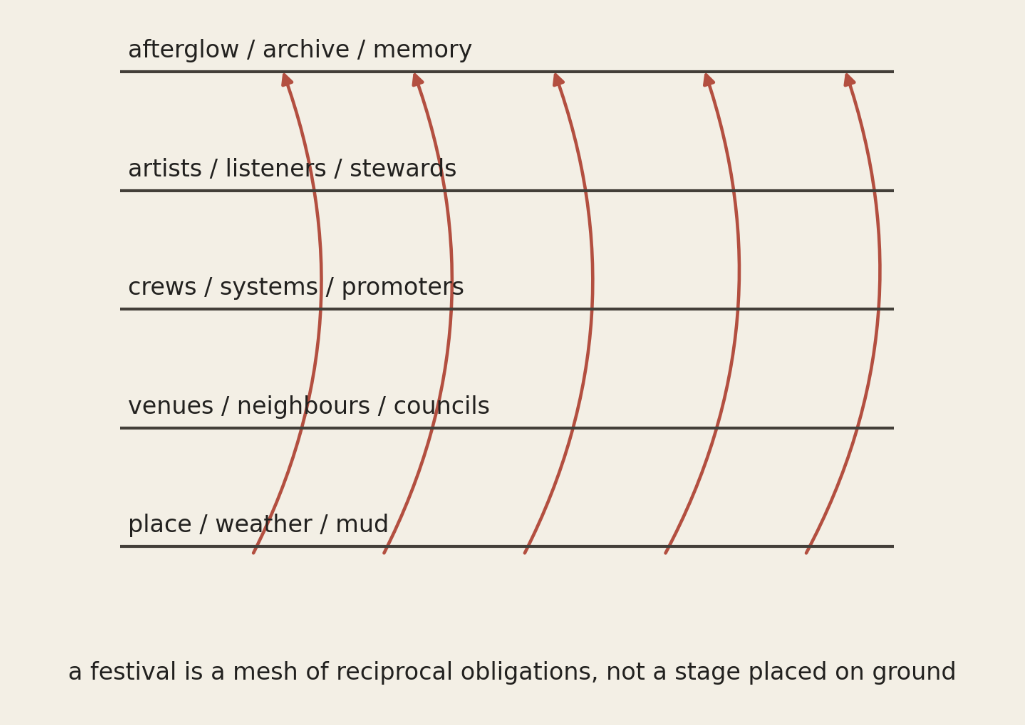 Figure 3: A social-ecological sketch of the room: from place and weather, through venues, neighbours and councils, into crews, artists, listeners, stewards, afterglow and archive.
VI. Materials, Infrastructures, Teachers
Then there are the infrastructures that make all this bodily. Mandrill Sound is central because the collective has publicly framed its ambition in clear terms: to bring high-fidelity, high-volume sound to a crowd and to hold adventurous bass music at full physical scale. A sound-system is not just hired hardware. It is social intention made physical. A stack teaches a crowd how to listen together. Bass does not merely decorate a dancefloor. It organises it.
Here the soundsystem can be understood as a boundary object. It is engineering problem, aesthetic instrument, welfare challenge, neighbourly risk, diasporic memory vessel and crowd-ritual machine all at once. This is why systems produce so much argument. They are not neutral infrastructure. They hold different publics in temporary relation: the technician tuning phase, the organiser worrying about nuisance, the dancer chasing pressure, the MC hearing history in the mic chain, the steward reading the room’s threshold of exhaustion, the local resident hearing low-end as intrusion.3A proper analysis has to keep all of those positions visible at once. To fetishise the stack as pure object is to miss its political life. To reduce it to compliance is to miss its magic. The soundsystem becomes a site of provisional study, an instrument through which a room learns itself.3 Fred Moten is useful here because the stack can be read as a site of fugitive planning: an improvised sociality that official categories are never quite able to contain.
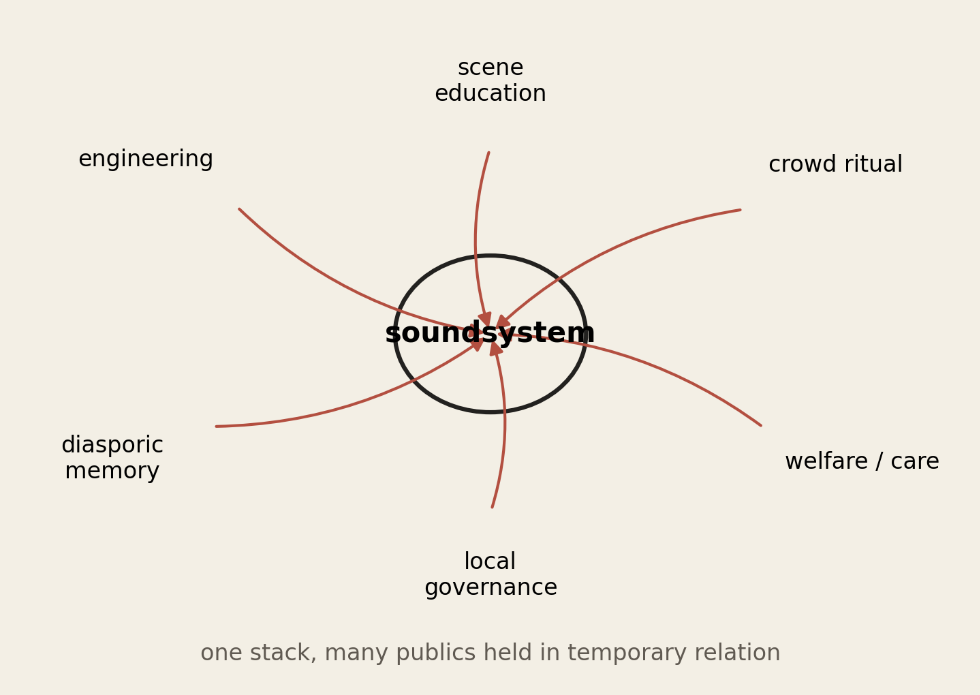 Figure 4: The soundsystem as boundary object: one stack, many publics held in
temporary relation.
The manifesto also has to name the Stroud Cypher, because the cypher reveals the heart of the whole project. A cypher is not merely a showcase. It is a format of relation. People gather in a circle, test one another, encourage one another, inherit and improvise at once. That is exactly what a local festival should be doing if it takes seriously the claim that rave is folk cultureThis is why Seasoning keeps circling sounds that are not always expected to meet under the same roof: UK techno, 140, bruk pressure, rap, diasporic dance music, downtempo drift and low-end psychedelia. Not as mood-board eclecticism, but as a practical social question. What happens when these people, frequencies, memories and energies are allowed to occupy the same temporary village?The answer is not unity in the thin sense. It is the chance for overlap. A chance for the dancefloor to become a commons where different histories can be held in proximity without being dissolved into content. Here the project touches both deep ecology and social ecology. The first names a respect for place, weather, terrain, mud, darkness, industrial edge, valley acoustics and the more-than-human conditions within which a festival is actually held. The second names the mesh of relations that make the gathering possible at all: friends of friends, crews, venues, volunteers, sound techs, neighbours, local authorities, local sceptics, old heads, first-timers and all the whispered trust that turns a plan into a room.
VII. Theses for a Local Festival
- Rave culture is folk culture because it is carried in use, not in branding
- It survives through rigs, edits, rewinds, favours, conversations and repeated gatherings.
- A town like Stroud can hold dubstep, bruk, techno, rap, diasporic dance music and ambient drift in the same hand without reducing them to content.
- Local scenes become durable when they are allowed to be porous.
- Hospitality matters because the room has to remain open to strangers without demanding sameness in return.
- A soundsystem is a teacher.
- Parties like Club Blanco, Cabin Fever, Spirit, JoyLift, Love Cuts, How We Met, Immigrant Party and Brown Excellence show different ways of keeping the commons alive. Seasoning’s task is not to imitate them but to let their energies cross-pollinate inside its own South West ecology.
- Escarpment futurism names a Stroud-situated horizon: a future built from edges, ridgelines and passing routes rather than from capitals alone.
This is the belief in full. Rave culture is folk culture because it is carried by participation, shaped by place and sustained through collective effort. It belongs to those who keep it moving.
VIII. Figure Plate
 Figure 5: Moon phase circle culminating in the 31 May 2026 blue moon, with dated phases distributed around the orbit and a ray extending inward to Stroud as both site and concept.
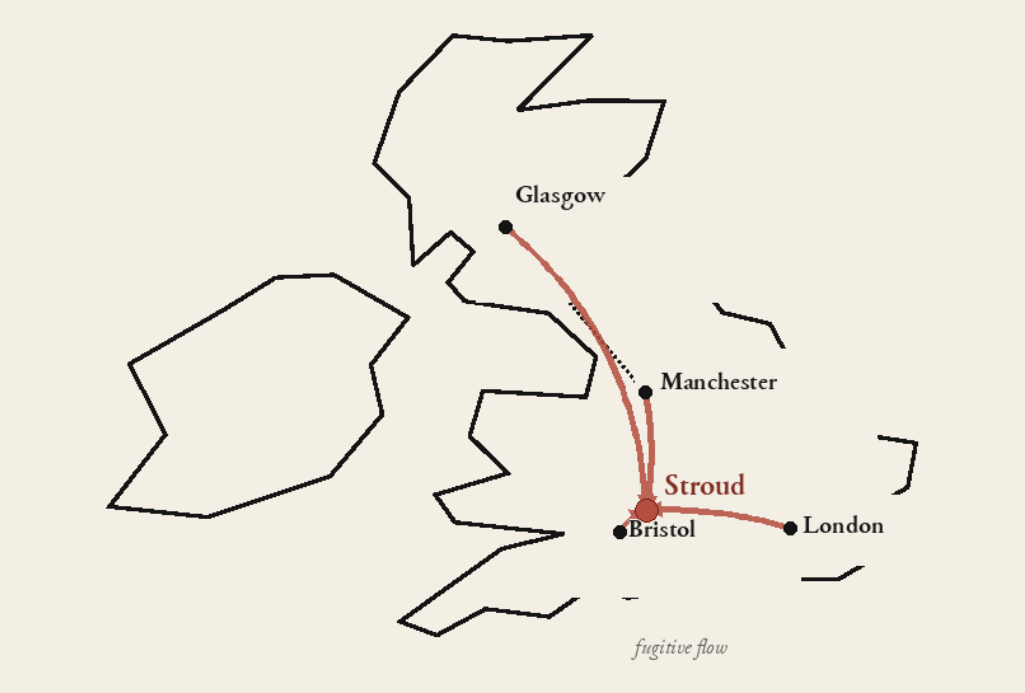 Figure 6: British Isles outline without national borders, labelled by partner-city nodes and by fugitive routes flowing along rail and road corridors into Stroud.